 HUATAO ROLLS
Before the RFQ: What to Confirm for a Wide-Web BOPET Chill Roll
Prepare a wide-web BOPET chill roll RFQ with verified dimensions, journal interfaces, speed, coolant duty, inspection criteria, and handling details.
Before requesting a quote for a wide-web BOPET chill roll, confirm the machine position, effective working face, mounting interfaces, operating speed, cooling duty, and acceptance criteria with the equipment OEM and plant engineering team. Use the approved station drawing to establish the roll dimensions. Nominal line width alone cannot establish the working face, overall assembly length, or clearance required for installation.
Define the roll at its machine position
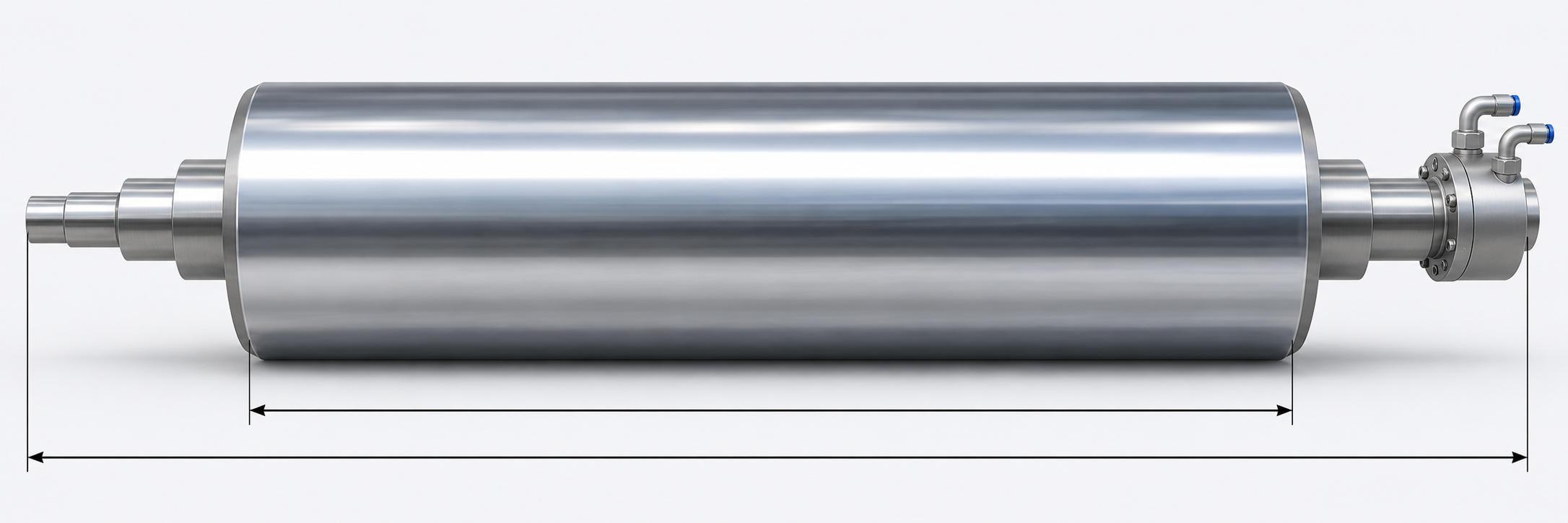
Start with the roll tag, station layout, and drawing revision. Dimension the effective working face and its location relative to the machine centerline. Specify the physical face length and total end-to-end length separately, stating whether the overall dimension includes removable fittings. Identify both ends of the assembly and show bearing centers, journal fits, shoulders, seal lands, and drive details where applicable. Confirm who supplies the bearings, housings, rotary unions, and couplings, and who approves the mating interfaces.
Specify operating speed and the cooling circuit
Provide the working diameter, normal and maximum operating speeds, and the applicable loads. Where the roll surface follows the web, use the web speed and working diameter to estimate roll RPM, then confirm the design speed with the OEM. Include loads from web tension and any contacting roll so the supplier can review the assembly for its intended duty.
Describe the coolant, inlet temperature range, required or available flow, and pressure at the roll connections. Identify supply and return locations, connection sizes, and rotary union interfaces. If the process requires a particular heat removal rate or cross-face temperature uniformity, state the operating conditions and measurement method used to verify it. Confirm that the proposed circuit can work within the plant’s available flow and pressure.
Agree on inspection and installation before ordering
Specify the surface finish, usable inspection zones, runout datum, and support conditions for measurement. Agree on the required balance, leak, pressure, or flow records as applicable, and identify which checks belong at the factory and which require the installed line. Have maintenance confirm the extraction direction, lifting arrangement, and clearances with the relevant fittings and lifting fixture in place. Ask the supplier for net mass, packed dimensions, and gross shipping mass.
RFQ verification checklist
- Approved station drawing and named owner for any interface changes.
- Working face, physical face, overall length, journal fits, and bearing centers.
- Operating RPM, load conditions, and cooling circuit requirements.
- Acceptance limits, test methods, and required inspection records.
- Handling envelope, packing details, and installation responsibilities.
Conclusion
Release the RFQ once the drawing, operating conditions, and inspection requirements describe the same assembly. That gives procurement comparable quotations and gives engineering and maintenance a common basis for acceptance and installation.
Preparing a specification? Review the HUATAO Chill Roll product page and contact Tony Liu with your station drawing, duty requirements, and acceptance checklist.