 HUATAO ROLLS
MDO Rolls
Select the roller by its job in machine direction orientation. Compare preheating, stretch and nip positions before defining the cover, surface, or thermal conditions.
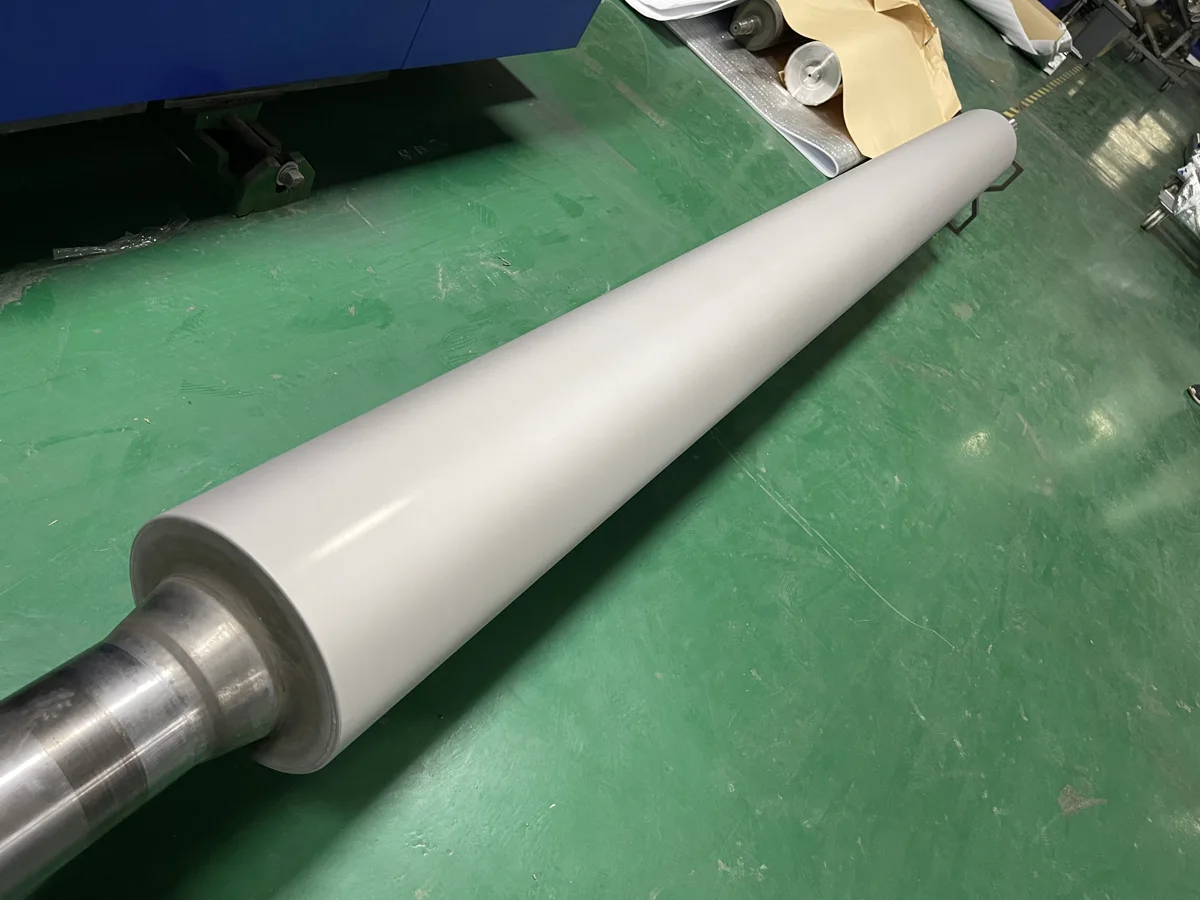
Rollers and configurations
| Product | Product description |
|---|---|
| MDO Nip Roll | At the MDO station of BOPP, BOPET and BOPA lines, the nip roll presses the web against its mating roll. A smooth, round and centered working surface supports continuous contact and helps distribute pressure across the film. The resilient silicone cover conforms at the nip under load. The catalogue specifies 45# steel for the shaft and shell and 70–80 Shore A for the silicone cover. It lists a working temperature up to 260 °C for the referenced configuration. Check the cover formulation, temperature exposure time, speed and load as a set, including any distinction between continuous and short-duration exposure. For a replacement, use the equipment drawing and original part reference to check the shell, shaft interfaces, mating roll geometry and nip pressure. |
| MDO Stretching Roll | This roller works in the machine-direction stretching section of BOPP, BOPET and BOPA lines. A smooth working surface and suitable release coating help the film pass through the stretching stage consistently. The film's mechanical and surface properties depend on the selected orientation conditions. The double shell has a fluid path formed with welded spiral guides. The catalogue lists out-of-roundness and cylindricity separately at ≤0.02 mm each, with chrome, ceramic, SCE release or tungsten carbide surfaces. Surface selection affects adhesion, wrinkles and tears during handling. Evaluate wear, chemical exposure and operating temperature before choosing a coating. These conditions also affect service life and replacement intervals. |
| MDO Preheating Roll | The preheating roll brings the web to its process temperature before it enters the longitudinal stretching section. Heated fluid passes between the inner and outer shells along welded spiral guides, transferring heat to the film through the roll face. Preheating prepares the film for orientation. Depending on the polymer and process settings, the combined heating and stretching process can influence tensile properties, stiffness, clarity and gloss. The original listing also describes downstream heat sealing and printing as film properties that can be influenced by processing. Chrome, PTFE, ceramic and tungsten carbide surfaces are listed. Review the working surface with the film type and cleaning process, and define how to verify the published ±0.5 °C temperature variation for the job. |